Bible Study Journey
The Bible is a living document. The Bible is a lifelong study.
RESTORATION
Bible of Restoration
12/9/20256 min read
Starting a Bible study can feel like opening a map of a continent you have never visited. It is vast, complex, and, if we are being honest, deeply intimidating. The Bible is not just a single book; it is a library of 73 books, written by many authors across thousands of years. Many people make the common mistake of starting at page one, the book of Genesis, with the best of intentions. They breeze through the majestic creation story and the drama of the patriarchs, only to find themselves lost in the intricate laws of Leviticus or the detailed censuses of Numbers. Without a clear path, the initial fire of curiosity often flickers out before one even reaches the end of the Pentateuch, or the first five books.
However, if I told you there was one definitive, "one-size-fits-all" place to start your journey, I would be lying. The Bible is a living document, and where you enter its pages often depends on the current state of your soul. Such a decision requires a moment of deep introspection. Before you even crack the spine of your Bible, I invite you to take a moment of stillness. Meditate on where you stand today with the people in your life, with your own inner peace, and, most importantly, with God.
Where is your heart leaning? What is the "hunger" you are currently feeling? By identifying your spiritual location, you can choose a starting point that acts as a bridge rather than a barrier.
If You Are Seeking Foundation: The Gospel of John
Connection? If you feel as though you have lost your connection with God, or perhaps have yet to truly establish one, the Gospel of John is your sanctuary. While the other three Gospels (Matthew, Mark, and Luke) focus largely on the chronological events of Jesus’ life, John focuses on the meaning behind the person. He is not just telling you what Jesus did; he is showing you who Jesus is.
The opening verse, John 1:1, sets the stage: “In the beginning was the Word, and the Word was with God, and the Word was God.” At first glance, such verses may seem like ancient riddles or abstract poetry. But as you slow down, you realize John is making a staggering claim: that the Creator of the universe stepped into our timeline to be known by us.
Specific truth you need for your current season in life. Starting here allows you to bypass the confusion of ancient genealogies and dive straight into the heart of the New Testament. It focuses on the identity of Jesus and his radical, sacrificial love for humanity. As you read John, do notrush. If a verse feels like a riddle, sit with it. Let God speak to you through the text and show you the specific truth you need for your current season in life. This book is designed to lead you to a place of belief, not just intellectual agreement, but a deep-seated trust that you are seen and loved by your Creator.
Where To Start: Beginning Your Bible Study Journey
If You Are Seeking Practicality: The Book of Proverbs
Struggling with "How" of daily life? Perhaps you already believe, but you find yourself struggling with the "how" of daily life. You might be facing difficult decisions at work, tension in your marriage, or the constant hum of anxiety that comes with modern living. If your goal is to practice faith in your everyday life, look no further than the Book of Proverbs.
God’s Book of Common Sense. Proverbs is often called "God’s Book of Common Sense." It is a collection of short, pithy sayings that contrast the path of the wise with the path of the foolish. It covers everything from how we handle our finances and our words, to how we choose our friends and manage our anger.
31 Chapters in Proverbs, 1 a Day. Introspection here requires looking at your habits. Ask yourself: "Where in my life am I making choices based on impulse rather than wisdom?" Proverbs provides a mirror. It doesn't just give you abstract theology; it gives you a blueprint for a life that "works" according to God’s design. Many people find success by reading one chapter of Proverbs a day, since there are 31 chapters, it fits perfectly into a monthly rhythm.
If You Are Seeking Emotional Resonance: The Book of Psalms
Emotional Depths of the Psalms Life is not always lived in the "logical" space of Proverbs; often, it is lived in the emotional depths of the Psalms. If you are currently walking through a season of grief, overwhelming joy, or even intense anger toward your circumstances, the Psalms are where you will find your voice.
The Psalms Provide A Vocabulary For Your Soul. The writers of the Psalms, most notably King David, were brutally honest with God. They shouted their questions, they wept over their failures, and they sang in their triumphs. If you feel like your prayers have become dry or repetitive, the Psalms provide a vocabulary for your soul. They show us that God is big enough to handle our doubts and our darkest emotions.
Learn How To Be With God. When you read a Psalm, try to find the one that matches your current heartbeat. Whether it is the peace of Psalm 23 or the desperate cry of Psalm 13. By starting here, you reinforce the idea that your relationship with God is not a performance, it is an authentic, emotional connection. You aren't just learning about God; you are learning how to be with God.
The Secret to Longevity: Quality over Quantity
The Bible is a Well Regardless of where you choose to start, the most important aspect of Bible study is not how much you read, but how much you absorb. We live in a culture obsessed with "streaks" and "completion rates," but the Bible is not a book to be checked off a list. It is a well to be drawn from.
Slow Reading" or Lectio Divina. Aim for "quality over quantity." It is far better to read three verses and let them reshape your heart than to read three chapters and remember nothing. This is where the discipline of "Slow Reading" or Lectio Divina comes in. Read a passage once to understand the context. Read it a second time and look for a specific word or phrase that jumps out at you. Read it a third time as a prayer.
One Simple, Transformative Question? Before you begin each session, create a "sacred space." This does not have to be a cathedral; it just needs to be intentional. Grab a notebook, find a quiet corner, and put your phone in another room. Before you even look at the text, bow your head and ask one simple, transformative question:
"God, what do you want to show me today?"
This prayer shifts you from being a "person" looking for information to a "disciple" looking for transformation. It acknowledges that you cannot understand the Word without the help of the Spirit who inspired it.
The Power of Introspection and Community
Prompt For Further Introspection As you begin, remember that you don't have to have it all figured out. The Bible is a lifelong study. If you hit a passage that makes you uncomfortable or confused, don't run away from it. Use that as a prompt for further introspection. Why does that verse bother you? What does it challenge in your current worldview?
Share Your Learning. Furthermore, while personal study is vital, do not stay in a vacuum. Share what you are learning with a friend or a small group. Often, God uses the insights of others to illuminate the "blind spots" in our own understanding. The map is big, and it is always better to travel with others.
Tools For Beginners
To help you stay organized and focused, here are a few recommended tools that can make your transition into regular study much smoother:
A Study Bible (NIV or NLT): If you are just starting, I highly recommend the New International Version (NIV) for its accuracy or the New Living Translation (NLT) for its readability. Most importantly, ensure it is a Study Bible. These include footnotes, maps, and introductions to each book that explain the historical and cultural context, answering the "who, what, and where" so you can focus on the "why." While such versions can be found online, a physical bible can help you find a quiet, secluded moment with God free of devices or modern distractions.
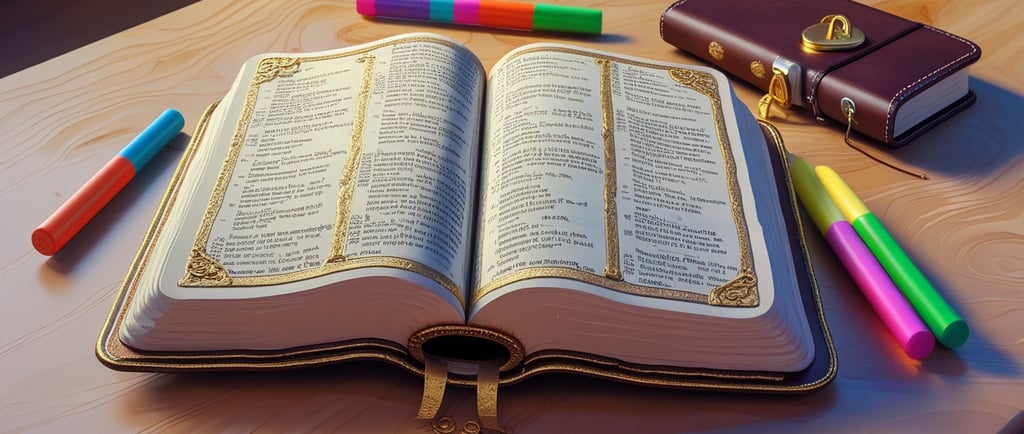
High-Quality Highlighters: Don't be afraid to mark up your Bible! It is a tool, not a museum piece. Use a color-coding system to help you categorize what you find. For example:
Blue for God’s promises.
Yellow for commands or instructions.
Green for personal growth or "Aha!" moments.
Pink for the words or character of Jesus.
A Simple Journal: This is your space to "process out loud." Record your thoughts, your questions, and your daily reflections. Looking back on a journal from a year ago is one of the most powerful ways to see how your faith has grown and how God has been working in your life, even when you didn't realize it at the time.
Bible Tabs: The Bible isn't chronological, and finding a specific book can be frustrating for a beginner. Stick-on tabs allow you to navigate the 73 books quickly, saving you time and reducing the barrier to entry when a pastor or friend mentions a specific verse.
The Bible In A Year Notebook: If you want to go a step deeper, The Bible in a Year Notebook is the perfect place to record your own journey through Scripture.
Starting this journey is the best decision you could ever make for your spiritual health.
Don't worry about being perfect; just be present.
God is ready to meet you in the pages of His Word.
God Restores!
Restoration is always possible. Psalm 23:3 states: "He Restores My Soul."
As Lamentations 3:22-23 says, "Because of the Lord's Great Love we are not consumed, for His compassions never fail. They are new every morning!
Great is Thy Faithfulness, Lord God!
Bible of Restoration
Inspiring faith through prayer, fasting, and divine restoration.
© 2026 BibleOfRestoration All rights reserved.
Contact us